Understanding Riverside's Unique Soil Composition
If you own property in Riverside, you're building on some of Southern California's most geologically complex terrain. The region sits atop a mix of decomposed granite, sandy loam, and expansive clay deposits that create a perfect storm for concrete problems. Unlike areas with stable, uniform soil, Riverside homeowners face constant ground movement that directly threatens the integrity of driveways, patios, and foundations.
Decomposed granite, or DG, is essentially weathered granite that has broken down into sand and gravel particles. While it's commonly used as a sub-base material for concrete work, it has a critical weakness: it lacks the stability of compacted engineered fill. When moisture infiltrates DG, it can shift and settle unevenly, creating voids beneath concrete slabs. This uneven support is one of the primary reasons riverside soil concrete cracking occurs so frequently in our area. The problem worsens during California's dry seasons when the soil shrinks, then expands again when winter rains arrive.
How Expansive Clay Causes Slab Heave and Cracking
Expansive clay is perhaps the most troublesome soil condition affecting concrete in Riverside. This type of clay contains minerals like montmorillonite that absorb water and expand significantly, then shrink as they dry. A single wet-dry cycle can cause clay to move several inches vertically, pushing up on concrete slabs from below. This phenomenon, known as expansive clay slab heave california, is responsible for some of the most dramatic and costly concrete failures homeowners experience. Unlike gradual settling, heave is violent and unpredictable, often occurring in just one season.
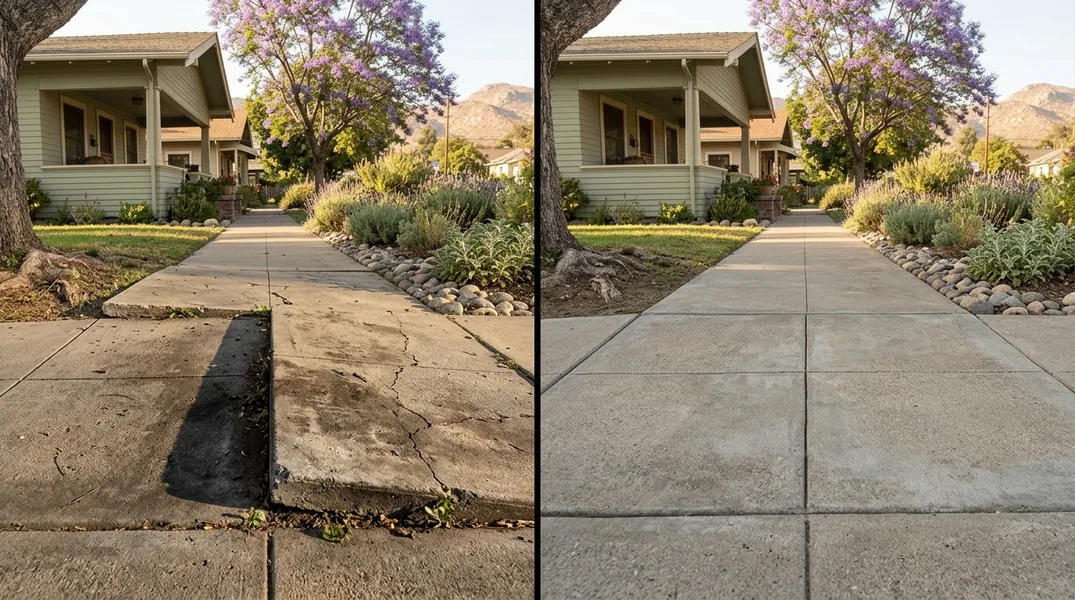
When expansive clay pockets exist beneath a driveway or Concrete Patios, the damage pattern is distinctive. You'll typically see a raised section in the middle of the slab with cracks radiating outward, or severe buckling that makes the surface unsafe to walk on. The problem is compounded because clay pockets aren't always evenly distributed. One section of your driveway might sit on stable soil while an adjacent section rests on clay, creating differential movement that concentrates stress on the concrete and accelerates cracking. This is why some driveways fail in just a few years while others last decades, even in the same neighborhood.
Why Standard Concrete Installation Fails in Riverside Soil
Many concrete contractors use a one-size-fits-all approach that works fine in areas with stable soil but fails spectacularly in Riverside. Standard practice typically involves laying a thin layer of recycled asphalt or inferior sub-base material, pouring concrete directly over it, and hoping for the best. This approach ignores the reality of local soil conditions. When that decomposed granite sub-base gets wet, it compacts unevenly. When expansive clay lies beneath, the concrete is essentially sitting on a time bomb waiting to shift.
Professional contractors who understand Riverside's geology take a completely different approach. They start with soil testing to identify clay pockets and determine the stability of the sub-base. They then use proper compaction equipment to create a stable foundation, often adding engineered fill or geotextile barriers to prevent clay movement and water infiltration. They also design concrete thickness and reinforcement specifically for local soil conditions, using wire mesh or rebar strategically placed to distribute stress. This added care during installation costs more upfront but prevents the far greater expense of Concrete Repair & Resurfacing down the road.
Prevention Strategies for Riverside Concrete Driveways
The best solution to riverside soil concrete cracking is prevention through proper installation. Concrete Driveways built in Riverside should start with a proper sub-base that's at least four to six inches thick and compacted in multiple passes. A decomposed granite sub-base must be tested for stability and moisture content before pouring. If clay pockets are present, contractors should consider removing and replacing that soil with engineered fill or using a stabilization method that prevents clay expansion.
Proper drainage is equally critical. Water is the enemy when dealing with expansive soil. A well-designed driveway includes a slight slope for surface water drainage and, ideally, a perimeter drain system to keep groundwater from accumulating beneath the slab. Some contractors also recommend installing a moisture barrier or geotextile between the sub-base and concrete to prevent capillary rise of water into the clay. Concrete thickness matters too. Riverside driveways should be at least four inches thick, with six inches recommended in areas with known clay problems. Thicker concrete distributes loads more effectively and is more resistant to cracking under stress from soil movement.
When to Call for Concrete Repair Near Me
If you're already seeing signs of trouble, don't wait. Early intervention can prevent minor cracks from becoming major structural problems. Common warning signs include a single long crack running across your driveway, multiple cracks forming a pattern, raised or sunken sections, or concrete that's visibly bowed or buckled. These symptoms indicate that soil movement is actively occurring beneath your slab. The longer you wait, the more the damage spreads, and the more expensive the repair becomes.
Concrete Repair & Resurfacing options depend on the severity of damage and the underlying cause. Minor cracks can be sealed to prevent water infiltration, which slows further damage. Moderate cracking might require concrete resurfacing to restore the surface while the underlying slab is still structurally sound. Severe heave or multiple large cracks often require removal and replacement of the affected section. Understanding what caused the problem is essential for choosing the right repair strategy. If you don't address the soil issue, a new driveway will fail the same way the old one did.
Concrete Driveways Cost in Riverside: What to Budget
When planning a Concrete Driveways project in Riverside, budget accordingly for the site-specific challenges our soil presents. A standard concrete driveway in a stable soil area might cost between $8 to $12 per square foot for basic installation. In Riverside, where proper soil preparation and testing are essential, expect to budget $10 to $15 per square foot or more, depending on soil conditions. This additional cost reflects the professional preparation required to prevent the cracking and heave problems that plague poorly installed driveways.
The investment in proper installation is significantly less expensive than dealing with repairs. A typical driveway repair for cracking or heave can cost $2,000 to $5,000 or more, and complete replacement runs $3,000 to $8,000 or higher depending on size. By spending extra upfront for proper site assessment, quality sub-base preparation, and appropriate concrete specifications, you're protecting your property investment. Get a free estimate from Riverside Concrete Pros that includes soil assessment. We'll explain exactly what your soil conditions require and provide transparent pricing based on the real conditions of your property, not generic assumptions. Call us at (951) 470-2469 to discuss your project.
Looking for a professional concrete contractor in Riverside? Riverside Concrete Pros responds fast for all your concrete needs.
Get a Free QuoteOur services: Concrete Driveways · Concrete Patios · Stamped & Decorative Concrete